

Section 498A of the Indian Penal Code (IPC) has been re-enacted as Section 85 of the Bharatiya Nyaya Sanhita (BNS), 2023, effective from 1 July 2024. If you are falsely accused under this law (धारा 498 से बचाव, 498 dhara se bachne ke upay), knowing your exact rights and the steps to take at each stage is what protects you and your family from wrongful arrest and a prolonged trial.
Key Takeaways:
- Section 498A was made to protect women from dowry harassment but is sometimes misused as a weapon. The Supreme Court has even called its wrongful use a form of legal terrorism against innocent families.
- Applying for anticipatory bail is the smartest first step if you sense a false 498A case coming. It protects you from immediate arrest while your lawyer builds a proper legal defense in court.
- You can approach the High Court to get a false FIR completely dismissed under Section 482 CrPC. The court can quash the case if strong evidence proves that the accusations are fake or exaggerated.
- A 2014 Supreme Court ruling made it mandatory for police to investigate before arresting anyone under 498A. This one ruling has significantly reduced wrongful and hasty arrests in dowry harassment cases across India.
- Saving all text messages, emails, call records, and financial documents can strongly prove your innocence in court. Good documentation and a trusted experienced lawyer are your two most powerful tools in fighting false cases.
What is Section 498A IPC/BNS Section 85?

Section 498A IPC, now BNS Section 85, criminalises cruelty by a husband or his relatives toward a married woman. Cruelty includes dowry-related harassment, physical abuse, and mental torture. The maximum punishment is three years of imprisonment and a fine. The offence is cognizable, non-bailable, and non-compoundable.
Is 498A abolished (kya 498A khatam ho gaya)?
The answer is no. Section 498A has simply been renumbered as BNS Section 85, with the same scope and punishment. All procedural references have also shifted:
- Anticipatory bail: BNSS Section 482 (earlier CrPC Section 438)
- FIR quashing: BNSS Section 528 (earlier CrPC Section 482)
- Regular bail application: BNSS Section 483
- Discharge from trial: BNSS Section 250 (earlier CrPC Section 227)
The Misuse of 498A: What the Courts Call Legal Terrorism
The Supreme Court described wrongful use of Section 498A as a form of “legal terrorism” (legal terrorism 498A). False 498A cases (झूठा 498A केस, fake 498, false 498A case by wife) are filed in some matrimonial disputes to gain leverage in divorce proceedings, extort money, or force property settlements. Parents, siblings, and in-laws are routinely named without specific allegations being made against them individually.
NCRB data shows a substantial proportion of 498A trials ending in acquittal or discharge, a trend Indian courts have consistently acknowledged when granting bail and quashing FIRs. If you have been falsely accused (false 498A, fake dowry case), the law gives you clear and powerful remedies at every stage.
Arnesh Kumar Guidelines: Police Cannot Arrest You Automatically
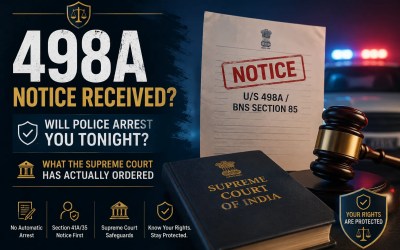
The Supreme Court in Arnesh Kumar v. State of Bihar, (2014) 8 SCC 273 issued binding directions on arrest procedure under Section 498A that remain fully applicable under BNS Section 85 (498A arrest guidelines, police procedure for arresting 498A). Read the full judgment on Indian Kanoon.
The key directions are:
- Police must assess whether an arrest is necessary using the checklist under BNSS Section 35 (earlier CrPC Section 41).
- The arresting officer must record written reasons before taking anyone into custody.
- Magistrates must actively apply their minds before authorising remand.
- An arrest cannot be automatic simply because the offence is non-bailable.
Violation of these directions makes the arrest illegal and gives you immediate grounds for bail. If police arrest any family member without following the Arnesh Kumar checklist, challenge it before the nearest Sessions Court or High Court the same day.
Step 1 – Apply for Anticipatory Bail Before an FIR is Registered

If you believe a false complaint is coming (धारा 498 से बचाव), apply for anticipatory bail under BNSS Section 482 immediately. Do not wait for the FIR to be registered.
Anticipatory bail:
- Protects you from arrest during the investigation phase.
- Is granted by the Sessions Court or, on appeal, the High Court.
- Remains in force until the trial court takes over the matter.
- Can be applied for by any accused family member, including parents and siblings.
For a detailed guide on how to apply and what documents are needed, read our post on anticipatory bail in dowry harassment cases. You can also visit our dedicated Anticipatory and Regular Bail service page.
Step 2 – Get the False FIR Quashed Under BNSS Section 528

If the FIR is already registered, you can petition the High Court to quash it under BNSS Section 528 (how to defend a 498A case, how to deal with 498A cases). High Courts quash false 498A FIRs in these situations:
- Allegations are vague and do not describe specific acts of cruelty by each named accused.
- All in-laws are roped in collectively without individual roles being stated (498A case in-laws quashed).
- The complaint surfaces only after matrimonial discord, not during the marriage itself.
- A genuine settlement has been reached between the parties.
False 498A case judgements from High Courts across India confirm that courts do not allow criminal law to be used as a weapon in matrimonial disputes when the allegations lack substance.
Step 3 – Build Your Evidence File

Evidence required to prove a false 498A case (evidence required to prove 498A) works in your favour at bail hearings, FIR quashing petitions, and at trial:
- WhatsApp chats, emails, and text messages show normal family relations.
- Call logs demonstrate regular contact with the wife before the dispute began.
- Photographs and videos from family functions show cordial relations.
- Financial transaction records proving no illegal dowry demand was made.
- Bank statements and wedding receipts documenting what was given voluntarily.
- Medical records confirming no injury to the complainant.
- Witness statements from neighbours, colleagues, and mutual friends.
During trial, cross-examination is your most powerful tool (cross-examination questions in 498A cases). Your lawyer must identify inconsistencies between the FIR, the Section 161 BNSS statement, and the chargesheet, and exploit them systematically across every prosecution witness.
Step 4 – File a Counter Case Against the False Complaint

Indian law gives you the right to fight back when someone files a false accusation (counter case against false 498A, false dowry case punishment in India, if someone makes a false accusation). You can file:
- Complaint under BNS Section 227 (equivalent of IPC Section 182): For giving false information to a public servant.
- Malicious prosecution claim: If the FIR was filed without reasonable cause and with the intent to harm.
- Defamation case under BNS Section 356: For reputational damage caused by false public accusations.
- Application under BNSS Section 379 (earlier CrPC Section 340): For perjury if witnesses lie during the 498A trial.
What happens if 498A is not proved in court?
The accused is acquitted, and that acquittal becomes the foundation for a counter case. The cost of defending a false 498A case, including mental harassment, financial loss, and reputational damage, can all be claimed in malicious prosecution proceedings.
Step 5 – Use Mediation as an Early Intervention
Courts increasingly recommend mediation in matrimonial disputes before criminal proceedings escalate (mediation). A mediated settlement can lead the complainant to approach the High Court to quash the FIR under BNSS Section 528, even though 498A is technically non-compoundable. This is the fastest route to closing a false case without years of trial. Read more about court mediation in family disputes on our website.
498A After Chargesheet: What Happens Next?
Many people ask what the case timeline looks like after the police file the chargesheet (what happens after the chargesheet is filed in 498A, 498 case kitne din tak chalta hai):
- The court takes cognisance and issues a summons.
- The accused appears, and the court frames charges under BNS Section 85.
- Prosecution examines its witnesses; defence cross-examines each one.
- Defence leads its own evidence and witnesses.
- Final arguments are heard from both sides.
- The court delivers its verdict.
A Sessions Court 498A trial typically takes between three and seven years. You can apply for discharge under BNSS Section 250 early in proceedings if the chargesheet does not disclose a prima facie case.
On travel abroad: If a 498A case is pending, travel requires prior court permission, as a lookout circular may be issued (498A permission to go abroad). Apply before the trial court or High Court well in advance of any planned travel.
498A with the Dowry Prohibition Act and the DV Act
498A cases often come paired with Sections 3 and 4 of the Dowry Prohibition Act, 1961 (498A 3 4 DP Act in Hindi, दहेज प्रतिषेध अधिनियम 1961 धारा 3 और 4). Section 3 penalises giving or taking dowry; Section 4 penalises demanding it. These require separate defences from your lawyer.
Domestic Violence Act complaints are also frequently filed alongside 498A, adding civil proceedings to the criminal case (498A DV Act). See our Domestic Violence and Dowry Harassment pages for how we handle combined cases.
Preventive Steps Before Any FIR is Filed
The best safeguard is acting before a complaint is registered (498 dhara se bachne ke upay):
- Keep all communication documented. Avoid arguments in formats that can be recorded without your knowledge.
- Maintain clear records of financial gifts and transactions made at the time of marriage.
- Save family photographs, group videos, and messages that show the nature of your relationship.
- If your spouse has left the matrimonial home, file for Restitution of Conjugal Rights under Section 9 of the Hindu Marriage Act to demonstrate your willingness to continue the marriage.
- If a complaint seems imminent, file a preventive complaint with the local police station first.
- Consult an experienced 498A defence lawyer at the earliest sign of a dispute.
Conclusion
A false 498A (BNS Section 85) case can be fought and won at every stage with the right legal strategy: anticipatory bail before arrest, FIR quashing at the High Court, a well-built evidence file, and a counter case where warranted. The key is acting fast. Advocate Preeti JD and her team handle 498A defence cases at Gurgaon Family Court and across Delhi NCR courts. Consult our family lawyers in Gurgaon or divorce lawyers in Delhi for immediate legal assistance.
FAQs
Is Section 498A still valid after BNS came into force?
Yes. Section 498A IPC has been re-enacted as Section 85 of the Bharatiya Nyaya Sanhita, 2023, with the same punishment of up to three years imprisonment and a fine.
Is 498A bailable or non-bailable?
Section 498A / BNS Section 85 is non-bailable. Bail must be applied for before a court; it is not a matter of right.
What is the maximum punishment in a 498A case?
Three years of imprisonment and a fine. There is no mandatory minimum sentence, and courts may award a lesser punishment depending on the facts.
Can police arrest me immediately after a 498A complaint?
No. Under Arnesh Kumar v. State of Bihar (2014), police must assess the necessity of arrest and record written reasons before taking anyone into custody. Automatic arrest is illegal.
What happens if a 498A case is not proved in court?
The accused is acquitted. The acquittal creates a legal basis for filing a counter case for malicious prosecution and damages against the complainant.
Can I file a counter-case against a false 498A?
Yes. You can file complaints under BNS Section 227 for false information to the police, for malicious prosecution, and for defamation. Evidence of the false accusation strengthens each counter case.
Is 498A compoundable? Can parties settle it privately?
No, it is non-compoundable. Parties cannot withdraw it by mutual agreement alone. However, the High Court can quash the FIR under BNSS Section 528 if a genuine settlement affidavit is filed.
Can in-laws be arrested under 498A?
Yes, but only if specific allegations of cruelty are made against each person individually. Vague, omnibus allegations against all in-laws are grounds for quashing the FIR or seeking discharge.
Can I travel abroad if a 498A case is pending?
Travel requires prior court permission. If a lookout circular has been issued, you must get it lifted by the trial court or High Court before leaving India.
How long does a 498A / BNS Section 85 case take?
Typically, three to seven years at the Sessions Court. Applying for discharge under BNSS Section 250 at an early stage, or getting the FIR quashed, can bring the matter to a close much faster.


0 Comments