

Key Takeaways
- There are two types of divorce in India, mutual consent and contested, and the procedure, timeline, and documents required differ significantly between the two.
- A divorce petition must be filed at the Family Court or District Court that has jurisdiction over the area where the couple last lived together, or where the wife currently resides.
- Mutual divorce typically takes 6 to 18 months. Contested divorce can take 2 to 5 years, depending on court backlog and case complexity.
- You need your marriage certificate, identity proof, residence proof, and relevant evidence before filing. Missing even one document can delay your case by weeks.
- As of 2026, you cannot file a divorce petition entirely online in most Indian states. Physical filing at the Family Court is still required, though e-Courts allow case tracking and some states permit partial e-filing.
- You are legally permitted to file for divorce without a lawyer in India, but the procedure involves personal-law selection, drafting, jurisdiction, evidence, and cross-examination. Self-representation is possible but rarely advisable.
- If the marriage was solemnised under Hindu, Muslim, Christian, Parsi, or the Special Marriage Act, the applicable statute, the grounds, and even the court differ. Identify the personal law that governs your marriage before you file anything.
Deciding to end a marriage is never easy. When you finally reach that point, the last thing you want is to feel lost about where to begin. If you have been searching for how to apply for divorce, how to file a divorce case in India, or simply want to understand what the full divorce process and procedure look like before you take any step, this guide is written for you.
What Is the Divorce Process in India?

The divorce process in India is the formal legal procedure by which a court dissolves a marriage. It is not a single uniform law: it depends on the religion under which the marriage was solemnised.
- Hindus, Sikhs, Jains, Buddhists: governed by the Hindu Marriage Act, 1955
- Muslims: governed by Muslim Personal Law and the Dissolution of Muslim Marriages Act, 1939
- Christians: governed by the Indian Divorce Act, 1869
- Parsis: governed by the Parsi Marriage and Divorce Act, 1936
- Inter-religious or registered civil marriages: governed by the Special Marriage Act, 1954
Regardless of which law applies to you, the divorce petition is filed at the Family Court or District Court with jurisdiction over the area where you and your spouse last lived together, or where the wife currently resides. The court examines the petition, serves notice to the other spouse, conducts hearings, and ultimately issues a decree of divorce.
At a very high level, every divorce case in India moves through six phases regardless of the personal law involved: (1) consultation and drafting, (2) filing at the correct family court, (3) service of summons on the other spouse, (4) mediation or reconciliation attempt, (5) evidence, cross-examination, or joint statement of consent, and (6) final decree. Where the case sits within these phases determines both timeline and cost.
Jurisdiction basics you should know before you file: the Family Courts Act, 1984 gives family courts exclusive jurisdiction over matrimonial matters in cities where they have been set up. In cities without a designated family court, the District Court hears the case. Under Section 19 of the Hindu Marriage Act, and the parallel provisions of the Special Marriage Act and other personal laws, a wife has the additional right to file where she currently resides, even if the matrimonial home was elsewhere. This flows from the Supreme Court’s 2019 ruling in Rupali Devi v. State of Uttar Pradesh and it is one of the most significant procedural protections available to women in Indian matrimonial law.
Mutual Divorce vs. Contested Divorce: Which Path Applies to You?
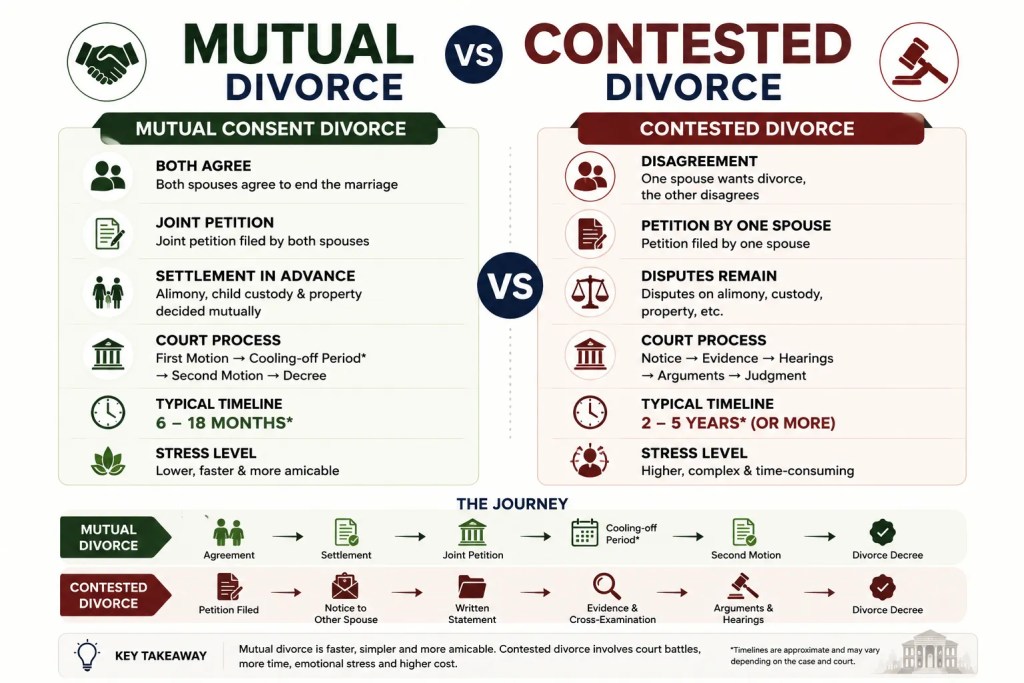
Mutual Consent Divorce
Mutual divorce is when both spouses agree that the marriage has broken down and want to separate without placing blame on either side. It is the faster, more affordable, and far less stressful route.
To apply for mutual divorce in India, three conditions must be met:
- Both parties must genuinely consent to the divorce
- The couple must have lived separately for at least one year
- Both parties must agree on alimony, child custody arrangements, and property division before the petition is filed
Under Section 13B of the Hindu Marriage Act, a joint petition is filed by both spouses. After a 6-month cooling-off period (which courts can waive if reconciliation is clearly impossible), the final divorce decree is granted. The typical timeline is 6 to 18 months.
Contested Divorce
A contested divorce is filed when one spouse wants to end the marriage, but the other does not agree, or when there are unresolved disputes over custody, property, or maintenance. The spouse filing the petition must prove valid legal grounds before the court.
Recognised grounds for contested divorce in India include:
- Cruelty: physical abuse or sustained mental harassment that makes living together unbearable
- Adultery: voluntary sexual intercourse with a person other than the spouse
- Desertion: one spouse abandoning the other for a continuous period of two or more years
- Conversion: one spouse converting to another religion
- Mental disorder: incurable mental illness preventing a normal married life
- Presumption of death: the spouse has been missing and unheard of for 7 or more years
Contested divorces are complex and time-consuming. They involve evidence submission, witness examination, and multiple court hearings. Expect a timeline of 2 to 5 years, sometimes longer in courts with heavy backlogs.
Divorce Under Muslim, Christian, and Parsi Personal Laws
Because divorce law in India is governed by the personal law of the parties, the exact procedure changes depending on the religion under which the marriage was performed. The seven-step framework in this guide applies to every personal law, but the grounds and terminology are different.
Muslim Personal Law
Muslim marriages are dissolved through several distinct mechanisms recognised by Indian courts:
- Talaq (by the husband): the historically Islamic mode of unilateral divorce. Since the Muslim Women (Protection of Rights on Marriage) Act, 2019, instantaneous triple talaq (talaq-e-biddat) is a criminal offence in India. The recognised forms today are talaq-e-ahsan and talaq-e-hasan, both of which require pronouncement across time periods with attempts at reconciliation.
- Khula (by the wife): the wife’s right to seek divorce by returning her mahr or other agreed consideration. Courts today do not require the husband’s consent for khula; the Kerala High Court’s 2021 judgment in K.C. Moyin’s case confirmed that the wife’s extra-judicial right to khula does not depend on his agreement.
- Mubara’at: mutual divorce by consent, similar in principle to Section 13B mutual divorce under the Hindu Marriage Act.
- Faskh: judicial dissolution under the Dissolution of Muslim Marriages Act, 1939, on grounds including desertion for four years, failure to maintain, cruelty, impotence, insanity, and conversion by the husband.
Talaq process in India is often searched by Muslim spouses seeking clarity on how to formally record a divorce. In practice, all forms of Muslim divorce should be registered with a competent authority and, where the parties want a court decree for maintenance, custody, or property, a petition can be filed in the Family Court under the Dissolution of Muslim Marriages Act or the Family Courts Act.
Christian Divorce Under the Indian Divorce Act, 1869
A Christian spouse can seek divorce under the Indian Divorce Act, 1869, as amended in 2001. The recognised grounds are adultery, cruelty, desertion for at least two years, conversion, incurable unsoundness of mind, communicable disease, presumption of death, and wilful refusal to consummate the marriage. Section 10A permits mutual consent divorce after two years of separation, followed by a six-month waiting period. The petition is filed in the District Court and then confirmed by the High Court for certain grounds.
Parsi Divorce Under the 1936 Act
Parsi marriages are governed by the Parsi Marriage and Divorce Act, 1936. Petitions are heard by special Parsi Matrimonial Courts constituted under the Act. Grounds include natural impotence, unsoundness of mind, adultery, cruelty, grievous hurt, desertion for at least two years, conversion, and non-consummation. Section 32B provides for mutual consent divorce after one year of separation.
Special Marriage Act, 1954
Inter-religious marriages, court marriages, and civil registrations are governed by the Special Marriage Act. The grounds mirror those under the Hindu Marriage Act, and Section 28 provides for mutual consent divorce after one year of separation. The petition is filed in the District Court.
How to Apply for Divorce in India: The Complete Step-by-Step Procedure
Step 1: Consult a Family Lawyer First
Before you file anything, speak to a qualified family lawyer. This is not optional. A lawyer will identify which personal law governs your marriage, advise you on the most appropriate grounds, help you assess whether mutual divorce is achievable, and prepare your petition correctly from day one. One error in the petition can set your case back by months.
Step 2: Prepare the Divorce Petition
The divorce petition is the formal written application that initiates the legal process. It must include the full names and addresses of both spouses, the date and place of marriage, details of any children, and the grounds for divorce or a declaration of mutual consent.
For a mutual divorce, both spouses sign the joint petition together. For contested divorce, only the petitioner signs, and the other spouse is served a court notice after filing.
Step 3: File the Divorce Case at the Family Court
Your lawyer files the petition at the correct family court along with all required supporting documents and the applicable court fee. The court registers the case, assigns a case number, and issues a summons to the other spouse. This is the official start of the divorce case filing procedure (तलाक का मामला दाखिल करने की प्रक्रिया).
Step 4: Court Hearing and Mediation
At the first hearing, the judge will typically refer both parties to a court-appointed mediator or counsellor. Courts are required under the Family Courts Act to attempt reconciliation before proceeding. If mediation fails or both parties confirm they do not wish to reconcile, the case moves forward.
For mutual divorce, both spouses record their free consent at this hearing. This is formally called the First Motion.
Step 5: Cooling-Off Period (Applicable to Mutual Divorce)
After the first motion, the court grants a 6-month cooling-off period. This is designed to give both parties time to reconsider. If both spouses remain firm after 6 months, the second motion is filed, and the case proceeds to the final stage.
Courts can waive this 6-month waiting period in cases where the couple has clearly and irretrievably separated, for example, where they have already been living apart for several years and all terms have been settled.
Step 6: Evidence and Hearings (Contested Divorce Only)
In a contested divorce, this is the most time-consuming stage. Both sides submit evidence, documents, photographs, medical reports, bank statements, and text messages, and present witnesses. Lawyers argue on behalf of their respective clients. The court examines everything carefully before forming a view.
Step 7: Final Decree of Divorce
Once the court is satisfied, either after the Second Motion in a mutual divorce or after a full trial in a contested divorce, it passes the Final Decree of Divorce. This is the legal document that formally ends the marriage. Keep certified copies of this decree in a safe place. You will need it for property transfers, passport updates, remarriage, and other legal purposes.
What Goes Into a Divorce Petition
A divorce petition is a structured legal document, not free-form correspondence. Every family court in India follows the same broad format, though local rules vary in font, spacing, and annexure order. If you are searching for a divorce petition form, understand that no single fillable “form” exists for a divorce petition. What exists is a drafting template that your lawyer will customise to your facts.
A typical contested divorce petition under the Hindu Marriage Act contains:
- Title and cause of action: the name of the court, the case type (e.g. HMA Petition), and the parties named as Petitioner and Respondent.
- Jurisdictional averments: paragraphs stating why this particular family court has jurisdiction. This will refer to the last shared residence or where the wife now resides.
- Personal law statement: a paragraph confirming that both parties were Hindu (or Muslim, Christian, etc.) at the time of marriage and remain so.
- Marriage particulars: date of marriage, place of marriage, ceremonies performed, and whether the marriage was registered.
- Children particulars: names, ages, and current residence of any children of the marriage.
- Grounds paragraph: for a contested case, this is where cruelty, desertion, adultery, or other statutory grounds are set out with specific facts, dates, and incidents. For a mutual petition under Section 13B, this paragraph states that the marriage has irretrievably broken down and that both parties have decided to separate.
- Reliefs sought: the specific orders the petitioner asks the court to grant, usually a decree of divorce, sometimes with additional prayers for permanent alimony, child custody, or property.
- Verification and affidavit: signed by the petitioner (both parties in a mutual case), affirming that the contents are true to the best of knowledge.
- Annexures: certified copy of the marriage certificate, ID proof, address proof, photograph, and documentary evidence for the grounds cited.
The petition is filed with the court fee applicable in that state (typically between Rs. 15 and Rs. 100 for the petition itself, plus process fees) and the physical volume of paper varies from about 15 pages for a straightforward mutual petition to several hundred pages for a contested case with detailed annexures.
Documents Required for Divorce in India
Gathering the right documents before filing saves time and avoids court delays. Here is the complete list based on your divorce type.
For all divorce types:
- Original marriage certificate with photocopies
- Identity proof of both spouses (Aadhaar, PAN, or passport)
- Residence proof of both spouses (utility bills, rental agreement, or voter ID)
- Passport-size photographs of both parties
- Birth certificates of children, if any
Additionally, for mutual divorce:
- Proof of living separately for at least one year
- Signed settlement agreement covering alimony, child custody, and property division
Additionally, for contested divorce:
- Evidence supporting the grounds cited (medical reports for cruelty, correspondence for desertion, court-admissible evidence for adultery)
- Income tax returns or salary slips of both parties
- Bank statements for the relevant period
- Property ownership documents, if property division is in dispute
Divorce Formalities: A Practical Checklist
Before you visit your lawyer for the first time, prepare the following:
- A one-page written summary of your marriage timeline and the sequence of events leading to the decision to separate.
- Original + two photocopies of every document listed above.
- A list of shared assets and liabilities (bank accounts, property, loans, jewellery).
- A list of children’s key details (school, current custody arrangement, extraordinary expenses).
- Screenshots or physical copies of any evidence you may want to rely on (messages, medical reports).
Divorce formalities in India are procedural rather than complex, but courts are strict about completeness. A missing document is the single most common cause of a delayed first hearing.
What If You Do Not Have the Marriage Certificate?
You can still file for divorce without a marriage certificate. Courts accept alternative proof of the marriage having taken place: wedding photographs, invitation cards, affidavits from officiating priests or witnesses, or ceremonies recorded in temple/gurdwara/mosque/church registers. If your marriage was solemnised but never registered, you may want to file for registration in parallel, since the divorce decree will refer to the marriage record.
Do You Need a Lawyer to File for Divorce in India?
You are legally permitted to represent yourself in a divorce case. There is no statutory bar on a party appearing in person. In practice, however, divorce is one of the areas of law where self-representation carries meaningful risk. Here is a clear breakdown of when a lawyer is more or less essential.
Situations where a lawyer is close to essential:
- Contested divorce with any evidence to argue (cruelty, adultery, desertion allegations).
- Cases involving substantial assets, business ownership, or ancestral property.
- Cases with children, where custody and visitation need to be structured.
- Cases with a foreign element (spouse abroad, foreign decree, cross-border service).
- Cases that involve parallel proceedings under Section 498A / BNS Section 85, the Protection of Women from Domestic Violence Act, or maintenance under Section 144 BNSS.
Situations where self-representation is theoretically possible:
- Uncontested mutual divorce with no children, no shared assets, and both parties in agreement on every point.
- Cases where both parties have already signed a comprehensive Memorandum of Understanding through mediation and only need the court’s formal decree.
Even in the theoretical self-help scenario, most family courts strongly prefer that parties appear through counsel because it speeds up proceedings, ensures the petition is correctly drafted, and reduces the risk of the case being sent back for procedural defects. If cost is the concern, mutual divorce lawyer fees in India are far more modest than contested divorce fees, and legal aid is available for those who qualify under the Legal Services Authorities Act, 1987, through the District Legal Services Authority in your area.
How to Take Divorce from Husband or Wife in India
In 2026, a wife in India has strong legal protections when filing for divorce. She can file at the Family Court in the city where she currently resides, even if the matrimonial home was in a different state. This removes a major practical barrier.
Under the Hindu Marriage Act, two additional grounds are available exclusively to wives:
- Bigamy: If the husband had a living spouse at the time of marriage
- Rape, sodomy, or bestiality committed by the husband after the marriage took place
A wife does not need her husband’s permission or consent to file a contested divorce petition. The process is the same: file the petition, attend hearings, and present evidence supporting the grounds cited.
For Husbands
A husband can file for divorce on any of the standard grounds: cruelty, desertion, adultery, mental disorder, or conversion. The petition is filed at the Family Court with jurisdiction over where the couple last lived together or where the wife now resides.
It is worth knowing that a husband cannot file a contested divorce on the ground of adultery against a co-respondent without proper evidence. Courts apply a high standard of proof in adultery cases.
Ex-Parte Divorce: What Happens If Your Spouse Does Not Appear?
A common concern for spouses filing contested divorce is what happens if the other side simply refuses to appear in court. The law has a clear answer: the court proceeds ex-parte.
When the summons has been properly served and the respondent still does not appear, and no valid reason for the absence is shown, the court records that fact and hears the case in the absence of the respondent. The petitioner leads evidence, witnesses are examined, and the court can pass an ex-parte decree of divorce if satisfied on the grounds pleaded.
Some important safeguards apply. The petitioner must strictly prove that summons was served (through registered post, court process server, and often newspaper publication). The respondent, once made aware, can file an application under Order IX Rule 13 of the Code of Civil Procedure to set aside the ex-parte decree, on grounds such as the summons never having been served or a valid reason for the earlier absence. If the court accepts the application, the case is restored and heard on merits.
Ex-parte divorces are a valid route but not a shortcut. Courts scrutinise service of process rigorously precisely because a decree obtained ex-parte permanently alters the respondent’s marital status. If your spouse has left the country, refuses to accept notice, or is untraceable, tell your lawyer this at the first consultation; the process for service by publication in a national daily takes several months.
Can You File for Divorce Online in India? (2026 Update)
As of 2026, a divorce petition cannot be filed entirely online in most Indian states. Physical filing at the Family Court through your lawyer remains the required first step. However:
- The e-Courts portal (ecourts.gov.in) allows you to track your case status, view hearing dates, and access cause lists from anywhere
- Several High Courts and Family Courts in states like Maharashtra, Karnataka, and Delhi have introduced partial e-filing for specific applications and interlocutory petitions
- Your lawyer can advise on what is available in your specific state as digital court infrastructure continues to expand in 2026
State-by-State E-Filing Status in 2026
- Delhi: The District Courts e-Filing portal accepts most family-side interlocutory applications online, and virtual hearings via Cisco Webex are routine. First filing of the main petition still requires physical presentation.
- Maharashtra: The Bombay High Court and Family Courts in Mumbai and Pune accept e-filing for most applications. Some Family Courts now permit e-filing of the main petition subject to defect scrutiny.
- Karnataka: The e-Filing 3.0 system launched under the Karnataka High Court permits e-filing of matrimonial matters at select courts. Bengaluru Family Courts are among the most digitally mature in the country.
- Tamil Nadu: The Madras High Court’s e-Filing infrastructure is in active use. Chennai Family Courts accept e-filing for applications; the main petition typically still needs to be filed physically.
- Other states: Digital infrastructure is being rolled out state by state through the eCourts Mission Mode Project. Assume physical filing is required unless your lawyer confirms otherwise.
Even where full e-filing is technically available, most family lawyers still prefer to file the main divorce petition physically because it reduces the risk of technical defects being flagged weeks later.
State-Specific Filing Notes: Maharashtra, Tamil Nadu, Karnataka, and Delhi NCR
While the seven-step procedure applies uniformly across India, the court venue, filing counter, court fee, and local case timelines vary by state.
Divorce Process in Maharashtra
Family Courts operate in Mumbai (Bandra), Pune, Nagpur, Aurangabad, and Nashik. Filing is done at the Family Court that has jurisdiction over the last shared matrimonial home or where the wife currently resides. Mumbai Family Court is one of the busiest in the country; expect first-hearing dates 4 to 8 weeks after filing. Marathi is accepted alongside English for pleadings in the Bombay High Court’s jurisdiction, though most family court practice remains in English.
Divorce Process in Tamil Nadu
Chennai has dedicated Family Courts at Chennai and Coimbatore. Petitions can be filed in Tamil or English. The Madras High Court has active reconciliation cells attached to family courts. Court fees are governed by the Tamil Nadu Court Fees and Suits Valuation Act, 1955.
Divorce Process in Karnataka
Bengaluru operates multiple Family Courts (Bengaluru Urban, Bengaluru Rural). Kannada-language filing is accepted but English is standard practice for divorce petitions. Karnataka has led on e-filing rollout for matrimonial matters, and virtual mediation is well established in Bengaluru courts.
Divorce Process in Delhi NCR
Delhi has six Family Courts (Saket, Dwarka, Karkardooma, Tis Hazari, Rohini, Patiala House). NCR extends jurisdiction into Gurugram (Haryana), Faridabad (Haryana), Noida and Ghaziabad (Uttar Pradesh) family courts. Which court you file in depends strictly on the address of the last matrimonial home or the wife’s current residence. A wife in Gurugram whose matrimonial home was in Noida can file in Gurugram Family Court. Delhi Family Courts commonly refer parties to the Delhi High Court Mediation and Conciliation Centre.
For families in Delhi NCR, Advocate Preeti JD and Associates file matters across all six Delhi Family Courts and the NCR courts in Gurugram, Noida, Faridabad, and Ghaziabad from the firm’s chamber at Gurugram District Court.
How Long Does the Divorce Process Take in India?
| Type of Divorce | Typical Timeline |
|---|---|
| Mutual Consent Divorce | 6 to 18 months |
| Contested Divorce | 2 to 5 years |
| With High Court appeals | 5 to 10 years |
| Cooling-off period (mutual) | 6 months (can be waived) |
| Minimum separation for mutual divorce | 1 year |
| Minimum desertion period for contested | 2 continuous years |
The single most common reason for delays is incomplete documentation at the time of filing. Have everything ready before your first appointment with a lawyer.
When the Cooling-Off Period Can Be Waived
In Amardeep Singh v. Harveen Kaur (2017), the Supreme Court held that the 6-month waiting period under Section 13B(2) of the Hindu Marriage Act is directory and not mandatory. Courts can waive it when the couple has already been separated for a substantial period, when all disputes on alimony, custody, and property have been fully settled, and when both parties genuinely want to move on.
Where the marriage has irretrievably broken down and the parties have no realistic possibility of reconciliation, the Supreme Court’s 2023 judgment in Shilpa Sailesh v. Varun Sreenivasan expressly authorises the Supreme Court to grant divorce under Article 142 of the Constitution without going through Section 13B(2). This is limited to cases before the Supreme Court, but it now regularly triggers waivers by family courts and High Courts in appropriate cases.
Divorce in Hindi and Hinglish: तलाक और डिवोर्स की प्रक्रिया
Many spouses in India search in Hindi or a mix of Hindi and English (Hinglish) when they first look for divorce information. The most common phrasings and what they mean in the legal sense are set out below.
- “Divorce kaise le?” and “Divorce kaise file kare?”: how to file for divorce.
The answer is the seven-step procedure above: consult a lawyer, prepare the petition, file at the correct family court, attend the first hearing, complete mediation, provide evidence (contested) or record consent (mutual), receive the decree.
- “Divorce lene ke liye sabse pehle kya karna padta hai?”: what is the very first step to take?
Consult a family lawyer to identify the personal law that governs your marriage and confirm which family court has jurisdiction over your case.
- “Divorce ke liye apply kaise kare?”: how does one apply.
You do not “apply” in the way you would for a certificate. Your lawyer files a divorce petition on your behalf at the appropriate family court.
- “Talaq kaise de?” / “Talaq procedure in India”: how to give talaq.
Under Muslim Personal Law, the recognised forms are talaq-e-ahsan and talaq-e-hasan; instantaneous triple talaq has been criminalised since 2019. A wife can seek khula, mubara’at, or judicial dissolution under the Dissolution of Muslim Marriages Act, 1939.
- “Mutual divorce ki procedure kya hai?”: what is the mutual divorce procedure.
Both spouses jointly file under Section 13B, appear for the first motion, complete the 6-month cooling-off period (or seek its waiver), then appear for the second motion, and the court passes the decree.
- “Divorce ka case kaise file kare Hindi mein?”
your lawyer can file pleadings in Hindi in family courts of Hindi-language states. English remains the working language of the higher judiciary.
Conclusion
The divorce process in India follows a clear legal path regardless of which personal law applies to you. The steps, from consulting a lawyer and preparing the petition to filing the case, attending hearings and receiving the final decree, are the same in structure, even if the timelines and grounds vary between mutual and contested divorce.
The best thing you can do right now, before you file anything or make any decision, is to speak to a family lawyer who understands both the law and the human reality of what you are going through. The right guidance at the beginning makes every subsequent step easier.
Advocate Preeti JD and Associates handle divorce and family law matters across Delhi NCR, Gurugram, Noida, Faridabad, Ghaziabad, and Mumbai. Reach out for a confidential consultation.
Frequently Asked Questions
What is the first step to applying for a divorce in India?
The first step is to consult a qualified family lawyer. They will assess whether your situation calls for a mutual or contested divorce, explain which personal law applies to you, and help prepare and file the divorce petition at the correct Family Court.
Can I file for divorce without a lawyer in India?
You are legally permitted to represent yourself, but it is strongly inadvisable. Divorce proceedings involve rights around alimony, child custody, and property. A single procedural mistake can delay your case for months or even lead to dismissal. Working with a family lawyer protects your interests at every stage.
What documents do I need to file for divorce in India?
You will need your original marriage certificate, identity proof for both spouses (Aadhaar, PAN, or passport), current residence proof, photographs, and relevant evidence for the grounds of divorce. For mutual divorce, you additionally need proof of one year of separation and a signed settlement agreement.
How long does a mutual divorce take in India in 2026?
A mutual consent divorce typically takes between 6 and 18 months. After filing the joint petition and attending the First Motion hearing, there is a mandatory 6-month cooling-off period. Courts can waive this period if both parties clearly wish to proceed and the marriage has irretrievably broken down.
Can a wife file for divorce without the husband’s consent?
Yes. A wife can file a contested divorce petition without the husband’s consent, on valid grounds such as cruelty, desertion, or adultery. The husband will be served a court notice, and both sides will be heard. His consent is not required for the court to grant the divorce.
What happens after the divorce petition is filed?
After filing, the court issues a summons to the other spouse. A hearing date is fixed. The court may refer both parties to mediation. If mediation fails or is not applicable, hearings proceed with evidence submission and arguments until the court passes the final divorce decree.
Is the 6-month cooling-off period mandatory for mutual divorce?
It is prescribed under the law, but courts have the discretion to waive it. The Supreme Court has held that courts can waive the waiting period if it is evident that the marriage has irretrievably broken down and both parties have already settled all terms, including alimony, custody, and property.
Can a divorce decree be challenged after it is granted?
Yes. A final divorce decree can be challenged by filing an appeal in the High Court within the prescribed limitation period. Valid grounds for appeal include fraud, misrepresentation, suppression of material facts, or serious procedural irregularities during the original trial. Once the limitation period expires without an appeal, the decree becomes absolute and final.
Can I file for divorce if I do not have my marriage certificate?
Yes. Courts in India accept alternative proof of marriage: wedding photographs, invitation cards, affidavits from priests or witnesses, or entries in religious institution registers. Your lawyer will guide you on the exact evidence acceptable in the particular family court, and you can file for retrospective marriage registration in parallel.
What happens if my spouse does not appear in court after being served?
If summons has been properly served and the respondent fails to appear without valid reason, the court proceeds ex-parte. The petitioner leads evidence, and the court can pass an ex-parte decree of divorce. The respondent can later apply under Order IX Rule 13 of the Code of Civil Procedure to set aside the decree if valid grounds exist.
How is the divorce process in Maharashtra different from other states?
The seven-step procedure is uniform across India. In Maharashtra, family courts operate in Mumbai, Pune, Nagpur, Aurangabad, and Nashik. Marathi and English are both accepted for pleadings in Bombay High Court territory. Mumbai Family Court is high-volume; first hearings are typically listed 4 to 8 weeks after filing.
Can I file for divorce online in India from abroad if I am an NRI?
An NRI cannot fully initiate a divorce petition online from abroad. The petition must be filed physically at the appropriate Indian family court through an authorised representative (often a family lawyer holding a valid Power of Attorney). Attendance at hearings can be arranged through video conferencing subject to court permission.
Can a Muslim wife take divorce without her husband’s consent in India?
Yes. A Muslim wife can seek divorce through khula, faskh, or by filing a petition under the Dissolution of Muslim Marriages Act, 1939. Courts have confirmed that the wife’s extra-judicial right to khula does not require the husband’s agreement. Grounds under the 1939 Act include desertion, non-maintenance, cruelty, and importance.



0 Comments
Trackbacks/Pingbacks