

Since the Supreme Court’s ruling in Rupali Devi v. State of Uttar Pradesh (2019), a wife can file a 498A IPC (now BNS Section 85) complaint where she takes shelter after leaving the matrimonial home, typically her parental hometown. This is in addition to the traditional jurisdiction where the alleged offence was committed. So if you live in Gurgaon and your wife has moved back to Lucknow, Patna, Kolkata or her parental city, she can legally file 498A or BNS 85 there. Your defence options include anticipatory bail in Gurgaon (your residence), a transfer petition under Section 448 BNSS (formerly Section 407 CrPC) or Section 447 BNSS (formerly Section 406 CrPC) to bring the case back to Gurgaon or a convenient forum, and a Section 528 BNSS (formerly Section 482 CrPC) quashing petition where allegations do not establish continuing cruelty.
Can my wife file 498A in her hometown: The Cross-State 498A Nightmare
You live in Gurgaon. Your wife has moved back to her parental home in another state. A 498A IPC (or BNS Section 85 in cases filed after 1 July 2024) FIR has been registered against you, your parents and your siblings at a police station 800 kilometres away. Every hearing means flights, hotel bills and missed workdays.
Is this legally permissible? After the Supreme Court’s 2019 ruling in Rupali Devi v State of Uttar Pradesh, yes. But the fuller answer, including your defence options, is what this 2026 guide covers.
The Old Position: Before Rupali Devi (2019)
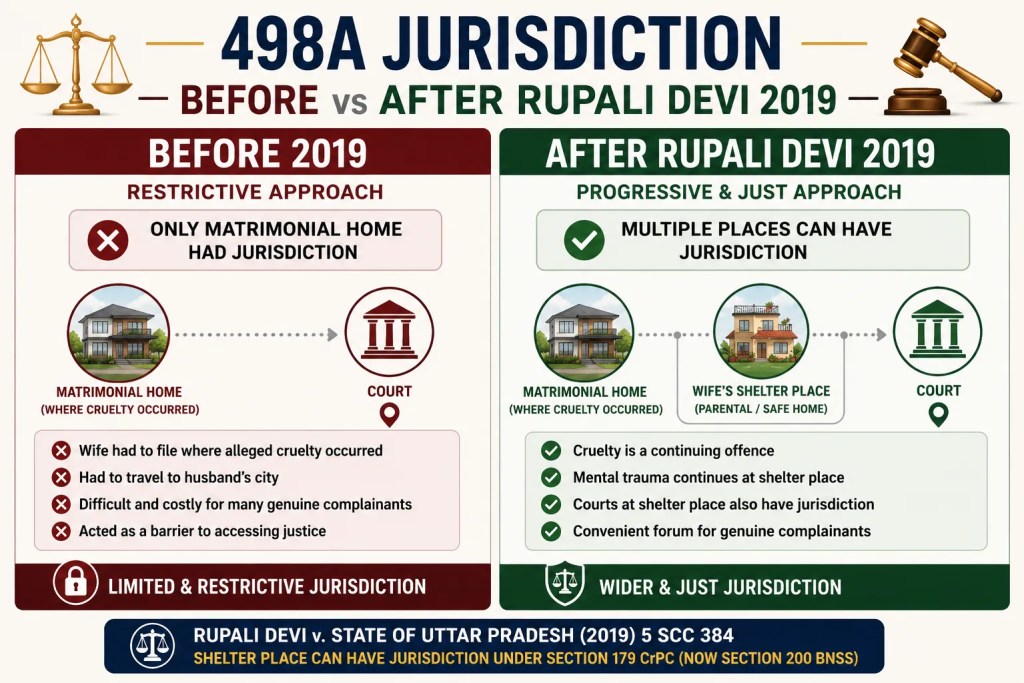
Before the 2019 Rupali Devi ruling, the position on 498A jurisdiction was fragmented and confused. Different High Courts read Section 179 of the Code of Criminal Procedure (now Section 200 BNSS) differently. The common view, backed by decisions like Y. Abraham Ajith v Inspector of Police (2004), was:
- 498A jurisdiction lies where the offence of cruelty was committed
- The offence of cruelty is committed at the matrimonial home
- Therefore, a wife who left the matrimonial home could not file at her parental home
- She had to file where the alleged cruelty occurred, typically the husband’s city
This created a filter that many wives found difficult to cross. A wife who had suffered cruelty in Gurgaon, then returned to her parental home in Lucknow, was told she had to travel to Gurgaon just to file the FIR. This was seen by many advocates and Bar Council observers as a barrier to genuine complaints.
Rupali Devi v State of UP (2019): What the Supreme Court Actually Held
In Rupali Devi v State of Uttar Pradesh (2019) 5 SCC 384, a three-judge bench of the Supreme Court, led by the then Chief Justice Ranjan Gogoi with Justice L. Nageswara Rao and Justice Sanjay Kishan Kaul, settled the confusion.
The court held that:
- Cruelty under Section 498A IPC (now BNS Section 85) is a continuing offence
- The mental cruelty suffered by the wife does not end when she leaves the matrimonial home
- Mental trauma continues at her parental home or wherever she takes shelter
- Under Section 179 CrPC (now Section 200 BNSS), a court has jurisdiction where the consequence of the offence ensues
- Therefore, courts at the wife’s shelter place also have jurisdiction to try the 498A or BNS 85 complaint
The core reasoning: the offence continues to affect the wife’s mental health at the place where she takes shelter, so that place has territorial jurisdiction to hear the matter.
The Practical Consequence: Where Can a Wife File 498A / BNS 85 in 2026?

After Rupali Devi, a wife has multiple valid jurisdictional options:
- The place where the alleged cruelty occurred, typically the matrimonial home
- The place where the wife currently resides after leaving the matrimonial home (parental home, sister’s home, safe residence)
- Any place where any part of the offence, including its mental consequence, continues
She can pick whichever forum is most convenient or strategically favourable. This is legally settled and no High Court in India today rejects a 498A or BNS 85 FIR purely on the ground that the wife filed at her shelter place.
What This Means for a Gurgaon Husband
If you live in Gurgaon and your wife has filed 498A / BNS 85 at her parental hometown, three legal realities apply:
- The FIR is jurisdictionally valid at that hometown court
- You will need local counsel in that jurisdiction, or your counsel will need to travel or brief a local
- You will need to attend hearings, or apply for exemption on grounds of distance under Section 205 CrPC (now Section 226 BNSS)
The situation is real, expensive, and often used strategically to pressure a husband into settlement. But it is not the end of your defence. Multiple procedural routes exist.
Can the Case Be Transferred Back to Gurgaon?
Yes, though transfer is discretionary and case-specific. Options:
- Section 447 BNSS (formerly Section 406 CrPC): Supreme Court transfer. Applied where the Supreme Court is satisfied that transfer between states is necessary for the ends of justice. Common in cross-state 498A matters where distance, safety, or fair-trial concerns are shown.
- Section 448 BNSS (formerly Section 407 CrPC): High Court transfer. Applied where the transfer is sought within the same state.
- Grounds commonly accepted: severe distance hardship, medical grounds, safety concerns, prior legal proceedings in another forum, and inability of both parties to attend at the wife’s forum without disproportionate cost.
Not every transfer petition succeeds. Courts weigh the wife’s right to convenience against the husband’s right to a fair, accessible trial. A well-drafted transfer petition supported by documentary evidence has a materially better chance.
Reference Table: Scenario vs Jurisdiction vs Defence Options
| Scenario | Wife’s Jurisdiction Options | Husband’s Defence Options |
|---|---|---|
| Wife left Gurgaon home, filed 498A in Lucknow | Lucknow (shelter) or Gurgaon (offence) | AB in Gurgaon; transfer petition; quashing in Allahabad HC |
| Wife still in Gurgaon home, filed 498A in Gurgaon | Gurgaon only | AB in Gurgaon Sessions Court; quashing in Punjab and Haryana HC |
| Wife moved to parents in Delhi, filed 498A in Delhi | Delhi (shelter) or Gurgaon (offence) | AB in Gurgaon or Delhi; transfer petition; quashing in Delhi HC or P&H HC |
| Wife working in Mumbai, filed 498A in Mumbai | Mumbai (shelter) or Gurgaon (offence) | AB in Gurgaon; Section 447 BNSS transfer petition; quashing petition |
| Cross-country: wife abroad | Complex, international jurisdiction | Anticipatory bail in India; challenge on jurisdiction and service |
Landmark Cases on 498A and BNS 85 Jurisdiction
- Rupali Devi v State of Uttar Pradesh (2019): Wife’s shelter place has jurisdiction; continuing offence doctrine applied to 498A
- Y. Abraham Ajith v Inspector of Police (2004): Earlier restrictive view, now superseded by Rupali Devi
- Arnesh Kumar v State of Bihar (2014): No automatic arrest in 498A; Section 41A CrPC (now Section 35 BNSS) notice mandatory before arrest
- Kahkashan Kausar v State of Bihar (2022): Omnibus and general allegations against extended relatives can be quashed
- Preeti Gupta v State of Jharkhand (2010): Cautioned against roping in distant relatives in matrimonial disputes
These five cases together form the current defence framework for a cross-state 498A / BNS 85 matter in 2026.
What About BNSS 2024: New Section Numbers
Since 1 July 2024, criminal procedure runs under the Bharatiya Nagarik Suraksha Sanhita 2023. Key section mappings for cross-state 498A defence:
- Section 41A CrPC → Section 35 BNSS (arrest notice for offences up to 7 years)
- Section 179 CrPC → Section 200 BNSS (offence triable where act done or consequence ensues)
- Section 406 CrPC → Section 447 BNSS (Supreme Court transfer between states)
- Section 407 CrPC → Section 448 BNSS (High Court transfer within state)
- Section 438 CrPC → Section 482 BNSS (anticipatory bail)
- Section 482 CrPC → Section 528 BNSS (inherent powers of High Court, quashing)
- Section 498A IPC → Section 85 and Section 86 BNS 2023
Rupali Devi’s holding continues to apply because the BNSS provisions are worded substantially the same as their CrPC predecessors.
Practical Defence Playbook for Cross-State 498A / BNS 85
- File anticipatory bail in Gurgaon Sessions Court immediately. Even though the FIR is elsewhere, the bail application can be filed at your residence court under Section 482 BNSS (formerly Section 438 CrPC).
- Collect documentary and digital evidence proving your version: WhatsApp chats with Section 63 BSA certificate, bank statements, CCTV footage, travel records.
- Engage local counsel at the wife’s forum to appear in day-to-day hearings, and coordinate strategy with your primary Gurgaon counsel.
- File a transfer petition under Section 447 BNSS in the Supreme Court, or Section 448 BNSS in the wife’s state High Court, supported by distance, hardship, and fair trial grounds.
- Prepare a Section 528 BNSS quashing petition in the wife’s state High Court for cases where allegations are vague, general, or fall within the Kahkashan Kausar test.
- Do not respond emotionally on WhatsApp, social media, or in phone calls. Every message becomes evidence.
For a deeper walk-through on the quashing route, our team runs false 498A case quashing for husbands as a regular practice area. On the prevention side, how to safeguard against 498A covers the pre-complaint precautions.
Common Mistakes Husbands Make with Cross-State 498A
- Ignoring the FIR because “she cannot file there anyway” (she can, per Rupali Devi)
- Missing the anticipatory bail window because they were trying to negotiate directly with the wife
- Assuming a transfer petition is automatic (it is not)
- Only engaging a Gurgaon lawyer without local counsel at the wife’s forum
- Not preserving CCTV, WhatsApp, and travel records that contradict the FIR timeline
Why Advocate Preeti JD
Advocate Preeti JD leads a 20+ member team focused only on family and matrimonial law, operating from Chamber No. 149, C-Block, District and Session Court, Gurugram. With 17+ years at the Supreme Court Bar Association and Punjab and Haryana HC Bar, her practice covers cross-state 498A defence, anticipatory bail, Section 528 BNSS quashing, dowry harassment and domestic violence defence. Gurgaon husbands engage our team as the best divorce lawyer in Gurgaon and the best family lawyer in Gurgaon, coordinating local counsel across India when the wife has filed at her parental forum.
Kya Aap Ki Wife Ne Bhi Apne Hometown Se 498A File Kar Diya Hai?
Bahut se Gurgaon husbands is situation mein aate hain: wife apne parents ke ghar chali gayi, aur wahan se 498A / BNS 85 FIR file kar di. Rupali Devi 2019 ke baad yeh legally valid hai. Lekin ghabraiye mat: anticipatory bail Gurgaon Sessions Court mein file ho sakti hai, transfer petition Section 447/448 BNSS ke tehat di ja sakti hai, aur quashing Section 528 BNSS ke tehat. Pehle 72 hours mein sahi legal advice lena zaroori.
Frequently Asked Questions
Can my wife legally file a 498A case in her parental hometown even if we lived in Gurgaon?
Yes. Since Rupali Devi v State of Uttar Pradesh (2019), a wife can file 498A IPC or BNS Section 85 at her shelter place. This is in addition to jurisdiction at the matrimonial home under the continuing offence doctrine.
Does the Rupali Devi ruling still apply after the new criminal laws in 2024?
Yes. Section 200 BNSS (successor to Section 179 CrPC) uses substantially the same language, and Section 85 BNS (successor to Section 498A IPC) is materially identical. Rupali Devi continues to govern jurisdiction in 2026.
Can I get anticipatory bail in Gurgaon if the 498A FIR is in another state?
Yes. Under Section 482 BNSS (formerly Section 438 CrPC), you can apply for anticipatory bail in the Sessions Court at your residence. Grant is subject to the court’s satisfaction and the strength of the FIR’s substance and your case.
How do I transfer the 498A case from my wife’s hometown back to Gurgaon?
File a transfer petition under Section 447 BNSS in the Supreme Court for inter-state transfer, or Section 448 BNSS in the relevant High Court for intra-state transfer. Grounds must show hardship, distance, or fair trial concern.
Are transfer petitions in cross-state 498A cases usually granted?
Not automatically. Courts balance the wife’s convenience against the husband’s fair trial rights. Well-drafted petitions supported by distance, medical, safety, or parallel proceeding grounds have materially better prospects of succeeding.
Can the FIR against my parents and siblings be quashed even if mine is not?
Yes, often. Under Kahkashan Kausar v State of Bihar (2022) and Preeti Gupta v State of Jharkhand (2010), omnibus allegations against distant relatives can be quashed at the High Court under Section 528 BNSS while trial continues against the principal accused.
Do I need a lawyer in both Gurgaon and my wife’s hometown?
In most cross-state 498A matters, yes. Primary counsel handles strategy, anticipatory bail, transfer and quashing petitions. Local counsel appears for day-to-day hearings at the wife’s forum. Coordination between the two is critical to a successful defence.
Can I be arrested at Gurgaon airport if the FIR is in another state?
Only in limited circumstances and after proper Section 35 BNSS notice compliance under Arnesh Kumar v State of Bihar (2014). Once anticipatory bail is granted, arrest is prevented. Filing anticipatory bail promptly is the first-line protection here.
What if my wife’s allegations are completely false and manufactured?
False allegations do not automatically defeat jurisdiction. You must file anticipatory bail first, then move for quashing under Section 528 BNSS with documentary evidence contradicting the FIR timeline. A civil defamation suit or Section 217 BNS complaint may follow.
How long does a cross-state 498A defence typically take?
Timeline varies by court roster and complexity. Anticipatory bail in Gurgaon typically within 7 to 21 days. Transfer or quashing petitions in the High Court or the Supreme Court take 6 to 18 months. Full resolution can extend 12 to 30 months in complex cases.



0 Comments