

If you are an NRI or OCI and you have already been divorced abroad, you may be carrying a quiet worry: Does that foreign divorce actually end your marriage in India? It is one of the most common questions our clients ask, often phrased exactly the way people search for it, like “videsh ka divorce India me valid hai ya nahi“ or “foreign divorce decree India me chalega kya“. The honest answer in 2026 is that it depends, and a recent Supreme Court ruling has made this more important than ever to understand before you remarry, sell property, or move on.
This guide explains, in plain language, when Indian courts recognise a foreign divorce, what the latest judgment means for you, and how to protect yourself from a costly mistake.
Is a foreign divorce automatically valid in India?
No. A divorce granted by a court in the USA, UK, Canada, Australia, or the Gulf is not automatically valid in India. For an Indian court to treat it as binding, the foreign decree must satisfy Section 13 of the Code of Civil Procedure, 1908, which means it must come from a court of competent jurisdiction, be decided on the merits, rest on a ground recognised under your Indian personal law, and respect natural justice. If even one condition fails, your Indian marriage may still legally exist.
The 2026 Supreme Court ruling every NRI should know
In March 2026, the Supreme Court of India delivered a judgment that NRIs cannot afford to ignore: Kishorekumar Mohan Kale v. Kashmira Kale, 2026 SCC OnLine SC 448. A Division Bench of Justices Vikram Nath and Sandeep Mehta set aside a Bombay High Court order and refused to recognise a divorce decree passed by the Oakland Circuit Court in the United States.
The couple had married in Mumbai in December 2005, according to Hindu rites and later lived together in the United States. After disputes, the wife filed for divorce before the US court, which granted a decree in February 2009 on the grounds of irretrievable breakdown, while the husband had filed his own petition before the Family Court in Pune. The Bombay High Court had held that Indian courts lacked jurisdiction and treated the US decree as valid. The Supreme Court disagreed and held the foreign decree was not conclusive or binding in India for two key reasons:
- The US court granted a divorce on the grounds of irretrievable breakdown of marriage, which is not a recognised ground under the Hindu Marriage Act, 1955, the law that governed this couple.
- The husband had not effectively participated in the foreign proceedings and had only contested jurisdiction, so he could not be said to have submitted to that court.
What the Hon’ble Court observed
The Bench made its reasoning plain. On the ground of divorce, it held that the foreign court had granted the decree on irretrievable breakdown, and that this “ground is not recognised under the HMA, which is the matrimonial law applicable to the parties.” On participation, it observed that the husband could not be said to have “voluntarily or effectively submitted to the jurisdiction of the foreign forum,” nor was he given a meaningful opportunity to contest. On the long deadlock, the Court noted that the parties had been separated since 2008 and that “no matrimonial bond subsists between them.”
Because the parties had been separated for nearly eighteen years, the Court then used its extraordinary power under Article 142 of the Constitution to dissolve the marriage itself on the ground of irretrievable breakdown, a power that only the Supreme Court holds. The important lesson is this: the couple still needed an Indian decree. The foreign judgment alone did not free them under Indian law.
This ruling sits squarely on the foundation laid in Y. Narasimha Rao v. Y. Venkata Lakshmi (1991), the case that continues to govern foreign divorce recognition in India. For a deeper case-focused read, see our companion analysis on why a US, UK or Canadian divorce is not automatically valid in India.
When is a foreign divorce decree valid in India?

Indian courts apply a clear test under Section 13 CPC. Think of it as a four-part checklist. Your foreign decree is recognised only if it clears all four.
1. Competent jurisdiction
The foreign court must have had jurisdiction that Indian law recognises, not merely jurisdiction under its own local rules. As a thumb rule, the spouses should be genuinely connected to that country, for example, by real residence or domicile. A decree obtained from a forum that neither spouse properly belonged to is on weak ground.
2. Decided on the merits
The decree must be based on the actual merits of the case. A purely ex parte order, passed only because one spouse did not appear and without examining the real grounds, is usually not treated as a judgment on the merits.
3. Ground recognised under your Indian personal law
This is where many NRIs are caught out. The foreign divorce must rest on a ground that exists under the law applicable to your marriage. For Hindus, that is the Hindu Marriage Act, 1955; for civil and inter-faith marriages, the Special Marriage Act, 1954. As the 2026 ruling confirmed, irretrievable breakdown alone is not a ground under the HMA, even though it is standard in many Western no-fault systems. If your matter is heading toward a fight, our contested divorce team can map the grounds that actually work in an Indian court.
4. Natural justice and effective participation
Both spouses must have received proper notice and a fair opportunity to contest. If your spouse was never properly served or was denied a real chance to be heard, the decree can be challenged in India on the principle of natural justice.
If you are mentally ticking “no” against any of these, it is wise to speak to an experienced NRI and OCI divorce lawyer before assuming you are legally free.
Why irretrievable breakdown trips up so many NRIs
In the USA, UK, Canada, and Australia, “irreconcilable differences” or “irretrievable breakdown” is often enough to obtain a divorce quickly. People naturally assume the same decree will work back home. Under Indian law, however, divorce is granted only on specified grounds such as cruelty, desertion, adultery, conversion, or by mutual consent. Only the Supreme Court, using Article 142, can dissolve a marriage purely on breakdown, and that power is not available to family courts or High Courts.
So a decree that was perfectly valid where you live can still leave your Indian marriage intact. This single gap is the root cause of most NRI divorce complications.
The bigamy and remarriage trap
This is the part that turns a paperwork problem into a serious legal risk. If your foreign divorce is not recognised in India, your first marriage still subsists under Indian law. A second marriage in that situation can be treated as void, and you may expose yourself to bigamy prosecution under the Bharatiya Nyaya Sanhita, 2023 (which replaced Sections 494 and 495 of the IPC).
We regularly meet clients who relied on a foreign decree, remarried, and only later discovered the problem when applying for a visa, dealing with property, or facing a complaint from the first spouse. The fix is almost always cheaper and faster before remarriage, not after. To understand the exposure in detail, read our guide on bigamy and second marriage laws under BNS Section 82.
NRI divorce kaise le India me? A step-by-step path
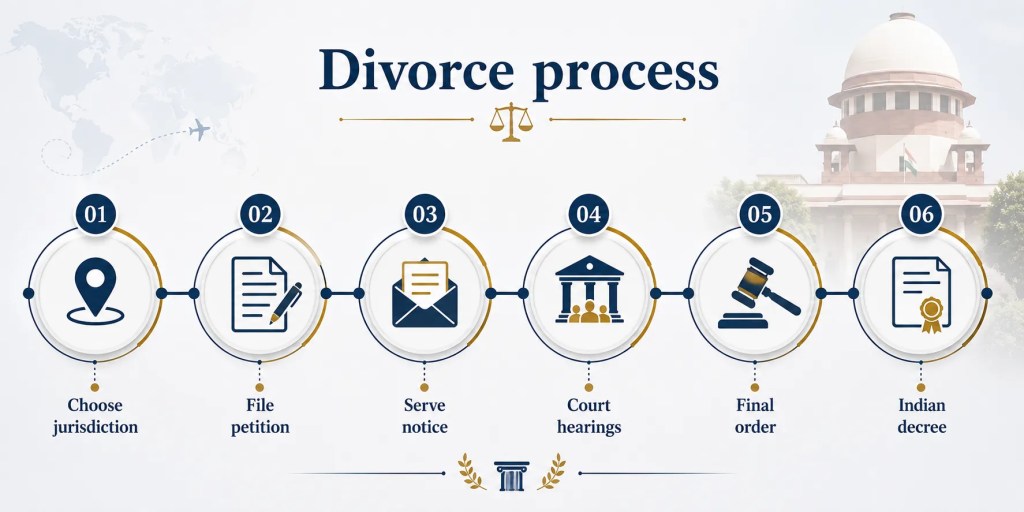
Many people search in Hinglish, asking “NRI divorce kaise le“ or “pati videsh me hai, talaq kaise le“. Here is the practical route when you want a clean, India-recognized divorce.
- Confirm your applicable law and jurisdiction. Under Section 19 of the Hindu Marriage Act, you can usually file where the marriage took place, where the respondent lives, where you last lived together, or where the petitioner resides if the other spouse is abroad.
- Choose mutual or contested. If both spouses agree, a mutual consent divorce is faster and less stressful. If not, a contested divorce petition is filed on a valid ground.
- File the petition in the correct Indian court. Accurate jurisdiction is critical because a wrong choice can be challenged later.
- Ensure proper service of summons. If your spouse is abroad, summons must be served through the correct channels. Improper service can sink an otherwise strong case.
- Attend hearings, including by video where permitted. Indian courts increasingly allow video conferencing in matrimonial matters, which reduces travel for NRIs, though it is subject to judicial discretion.
- Obtain and preserve the Indian decree. This is the document that actually protects you for remarriage, property, and immigration purposes.
For a fuller walkthrough, see our step-by-step guide on how to file for divorce in India and, if you and your spouse agree, how to proceed for a mutual divorce. NRIs who cannot travel should also read our guide on NRI mutual consent divorce without traveling to India.
Documents that NRIs usually need
- Marriage certificate or proof of marriage, apostilled if executed abroad
- Passport and visa copies of both spouses
- Proof of foreign residency or domicile
- Address proof in India, where jurisdiction is claimed
- Evidence supporting the grounds, such as communications, photographs, or records
- A copy of any foreign decree already obtained
Apostille and document legalisation often cause six to eighteen months’ delays when handled incorrectly, so getting this right early saves real time. For more information, read the apostille service.
Common mistakes NRIs make (and how to avoid them)

- Assuming the foreign decree ends everything. It may not, as the 2026 ruling shows.
- Remarrying before confirming Indian recognition, which risks a void marriage and bigamy exposure.
- Mailing only a lawyer’s notice from abroad and treating it as a filed case. It is not.
- Filing in the wrong Indian court, which invites a jurisdiction challenge.
- Ignoring maintenance, custody, and property, which Indian courts decide under Indian law regardless of the foreign decree. Our pages on maintenance of wife, children, and parents explain these rights, and for cross-border cases, see NRI divorce and child custody, and how much alimony an NRI wife can claim.
A short consultation at the start usually prevents all five. You can also read our overview of the common challenges and legal solutions in NRI divorce cases.
How Advocate Preeti JD helps NRI clients
Advocate Preeti JD, Associates and Solicitors, focuses entirely on family and matrimonial law, and cross-border NRI divorce is one of the firm’s core strengths. Advocate Preeti JD has over seventeen years of experience guiding NRIs and OCI cardholders across the USA, UK, Canada, Australia, and the Gulf through exactly these situations, with a calm, confidential, and result-oriented approach. The team helps you:
- Assess whether your foreign decree is recognisable under Section 13 CPC
- File or contest a divorce in the correct Indian jurisdiction
- Handle service of summons on a spouse living abroad
- Protect your interests on maintenance, child custody, and property
- Secure a clean, India-recognised decree so you can remarry safely
If you are unsure where you stand, a confidential consultation will give you clarity before you take any irreversible steps. The firm represents NRI clients across the country, with dedicated teams such as the best divorce lawyer in Gurgaon, the best divorce lawyer in Delhi, the best divorce lawyer in Mumbai, and a trusted family lawyer across Delhi NCR. You can reach the office at the numbers below or simply book an appointment online.
Frequently Asked Questions
Is a US or UK divorce automatically valid in India?
No. A foreign divorce is recognised in India only if it satisfies Section 13 CPC, including competent jurisdiction, a decision on merits, a ground valid under Indian personal law, and natural justice. Otherwise, your Indian marriage may still subsist.
Can I remarry in India after a foreign divorce?
Only after confirming that Indian law recognises your foreign decree. If it is not recognised, your first marriage subsists, the second marriage can be void, and you may face bigamy prosecution under the Bharatiya Nyaya Sanhita.
What if my foreign divorce was ex parte?
An ex parte decree, granted because one spouse did not appear, is often not treated as decided on the merits. The affected spouse can challenge it in India if proper notice or a fair hearing was denied.
Which Indian court has jurisdiction over my NRI divorce?
Under Section 19 of the Hindu Marriage Act, you can usually file where the marriage took place, where the respondent resides, where you last lived together, or where the petitioner resides if the spouse is abroad.
Do I have to be physically present in India for the case?
Not always. Indian courts increasingly permit video conferencing in matrimonial matters, though it depends on judicial discretion, and certain steps may still require presence. An NRI divorce lawyer can advise on your specific case.
NRI divorce kaise le agar pati ya patni videsh me hai?
File in the correct Indian court, ensure the summons is properly served abroad, and proceed on a valid ground or by mutual consent. Avoid relying only on a notice sent from abroad, as that does not start a valid case.
What did the Supreme Court decide in the 2026 NRI divorce case?
In Kishorekumar Mohan Kale v. Kashmira Kale (2026), the Court refused to recognise a US decree based on irretrievable breakdown and instead dissolved the marriage itself under Article 142, confirming foreign decrees are not automatically binding.
Is a Dubai, Canadian, or Australian divorce valid in India?
The same test applies everywhere. A decree from Dubai, Canada, Australia, or the UK is valid in India only if it meets Section 13 CPC and rests on a ground recognised under your Indian personal law. Verify before remarrying.
Can my spouse in India challenge my foreign divorce?
Yes. A spouse can challenge a foreign decree in India if the foreign court lacked jurisdiction, the order was ex parte, the ground is not valid under Indian law, or natural justice was denied. Indian courts will examine it independently.
Videsh ka talaq India mein valid karwane ke liye kya karna padta hai?
You usually need a fresh decree from an Indian court, or recognition of the foreign decree, only if it satisfies Section 13 CPC. An NRI divorce lawyer can confirm which route fits your case before you remarry or transfer property.


0 Comments