

Domestic violence (घरेलू हिंसा) is not limited to physical beating. Indian law recognises verbal abuse, mental harassment, economic deprivation, and sexual coercion as equally actionable forms of domestic violence. If you need legal assistance for domestic violence (कानूनी सहायता), understanding both civil and criminal remedies is the first step toward safety and justice.
Key Takeaways:
- Domestic violence (घरेलू हिंसा) includes physical beating, verbal abuse, mental harassment, sexual abuse, and economic deprivation under the Protection of Women from Domestic Violence Act, 2005 (PWDVA).
- Section 498A IPC has been replaced by Section 85 and Section 86 of the Bharatiya Nyaya Sanhita (BNS) from 1 July 2024. Criminal consequences for abusers remain fully in force.
- Victims can apply for a restraining order, called a Protection Order under PWDVA, directly through the Magistrate’s Court. Courts can grant it within 24 to 48 hours in urgent cases.
- A domestic violence case (DVC case) can be registered at a police station, before a Protection Officer, or directly in the Magistrate’s Court.
- Civil relief under PWDVA and criminal action under BNS Section 85 can run simultaneously.
- Women in live-in relationships, daughters, and sisters living in the household are also protected under PWDVA.
What is Domestic Violence Under Indian Law? (घरेलू हिंसा क्या है)

The Protection of Women from Domestic Violence Act, 2005 defines domestic violence under Section 3 as any act, omission, or conduct that harms, injures, or endangers the health, safety, life, or well-being of an aggrieved woman within a domestic relationship. The four categories under the women harassment act (महिला उत्पीड़न अधिनियम) are:
- Physical abuse: assault, beating, pushing, or bodily harm (पति द्वारा मारपीट).
- Verbal and emotional abuse: insults, humiliation, threats, and mental torture (मानसिक उत्पीड़न). Repeated verbal harassment is actionable even without physical injury.
- Sexual abuse: forced sexual relations, coercion, or harassment within the domestic relationship.
- Economic abuse: denial of money, restriction on property or assets, or total financial control over the woman.
Harassment linked to unlawful dowry demands (दहेज उत्पीड़न) also falls within this definition. A single incident is sufficient. You do not need to show a prolonged pattern of abuse to approach the court.
Verbal Abuse and Mental Harassment: Is It Domestic Violence? (मौखिक दुर्व्यवहार और मानसिक उत्पीड़न)
Yes. The Verbal Abuse Law in India explicitly recognises emotional abuse as domestic violence. Many victims do not realise that constant insults, public humiliation, threats of harm, controlling behaviour, and isolating a woman from her family all constitute legal grounds for action under both PWDVA and BNS Section 86.
Mental harassment case section (मानसिक उत्पीड़न की धारा): BNS Section 86 defines cruelty as wilful conduct likely to drive a woman to suicide or cause grave mental or physical injury. Repeated verbal abuse causing psychological damage is therefore a criminal offence under Section 85, read with Section 86 BNS. You do not need visible physical injuries to file a DVC case based on emotional abuse alone. Courts have consistently upheld that sustained psychological harm is as serious as physical violence.
Husband Beating Wife: Which Section Applies? (पति द्वारा मारपीट पर कौन सी धारा)
From 1 July 2024, the old IPC Section 498A was replaced by Section 85 of the Bharatiya Nyaya Sanhita (BNS). If a husband or his relative subjects a woman to cruelty, these are the applicable provisions:
- BNS Section 85: Husband or relative of the husband subjecting a woman to cruelty. Imprisonment up to 3 years and a fine. Cognizable and non-bailable.
- BNS Section 86: Defines cruelty as (a) wilful conduct likely to drive a woman to suicide or cause grave injury, and (b) harassment for unlawful dowry or property demands.
- PWDVA Section 3: Covers physical, verbal, sexual, and economic abuse, giving civil remedies in parallel.
For dowry-related cruelty and harassment, you can combine a PWDVA petition with an FIR under BNS Section 85. If the accused has applied for anticipatory bail, refer to the guide on anticipatory bail in harassment cases.
How to Get a Restraining Order in India (भारत में रेस्ट्रेनिंग ऑर्डर कैसे प्राप्त करें)

In India, a restraining order is legally called a Protection Order under Section 18 of PWDVA. It is passed by the Magistrate’s Court and legally prohibits the abuser from:
- Committing any further act of domestic violence
- Contacting you by phone, message, or through third parties
- Entering your workplace, children’s school, or any place you regularly visit
- Alienating shared assets or isolating you from your support network
How to get a restraining order against someone in India (रेस्ट्रेनिंग ऑर्डर के लिए आवेदन):
File a petition in the Magistrate’s Court through a Protection Officer or directly through a lawyer. In urgent situations, the Magistrate can grant an ex parte interim Protection Order at the very first hearing, without the abuser being present. This can be secured within 24 to 48 hours of filing. Violating a Protection Order is a criminal offence punishable with up to one year imprisonment or a fine of Rs. 20,000, or both.
How Long Does a Protection Order Take?
An interim ex parte Protection Order can be granted at the first hearing itself, often within 24 to 48 hours. A final permanent Protection Order requires both parties to be heard and typically takes several weeks to a few months, depending on the court’s schedule. Domestic violence petitions receive priority listing in the Magistrate’s Courts.
Where to Register a Domestic Violence Case (DVC Case) (घरेलू हिंसा का मामला कहाँ दर्ज करें)
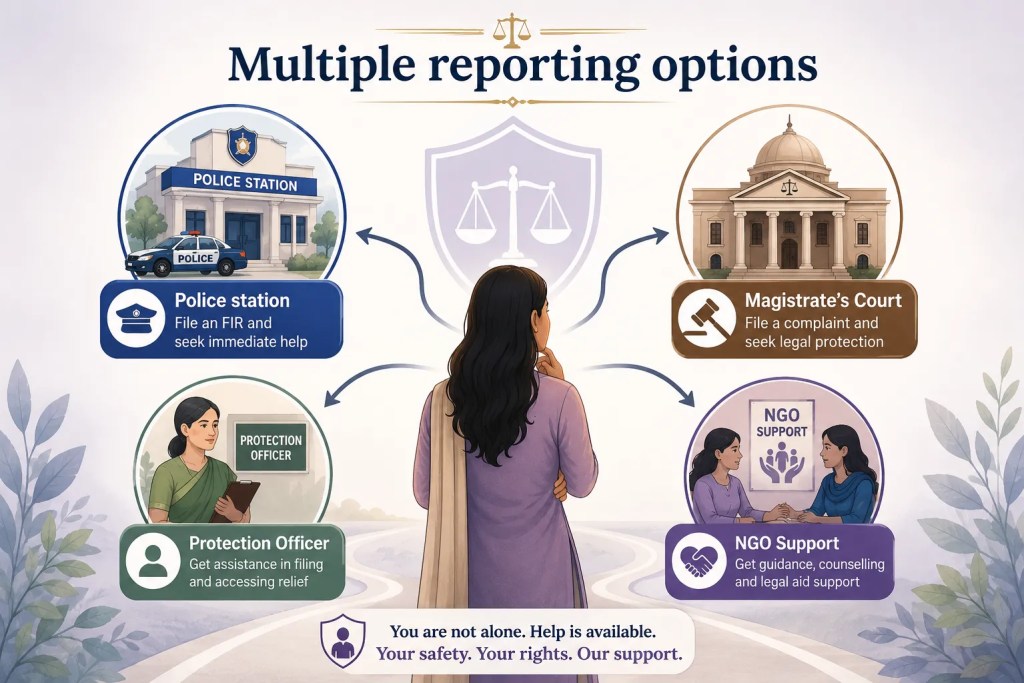
You can approach any of the following. You do not have to choose just one:
- Protection Officer: Every district has a designated Protection Officer under PWDVA. They prepare the Domestic Incident Report (DIR) and file your petition in court, free of charge.
- Police Station (FIR for domestic violence): File an FIR under BNS Section 85. If the officer refuses, approach the Superintendent of Police under Section 173 BNSS or file directly before a Magistrate under Section 223 BNSS.
- Magistrate’s Court directly: You can file a complaint petition under PWDVA directly without going to the police first. This is often the fastest route for emergency relief.
- Recognised NGO or Service Provider: Registered NGOs under PWDVA can assist you in filing a complaint and preparing the DIR.
The fastest route for immediate protection is approaching the Magistrate’s Court directly with a domestic violence lawyer, who can file for an emergency ex parte restraining order the same day.
Filing a Complaint and Seeking Protection Orders (घरेलू हिंसा शिकायत कैसे करें)
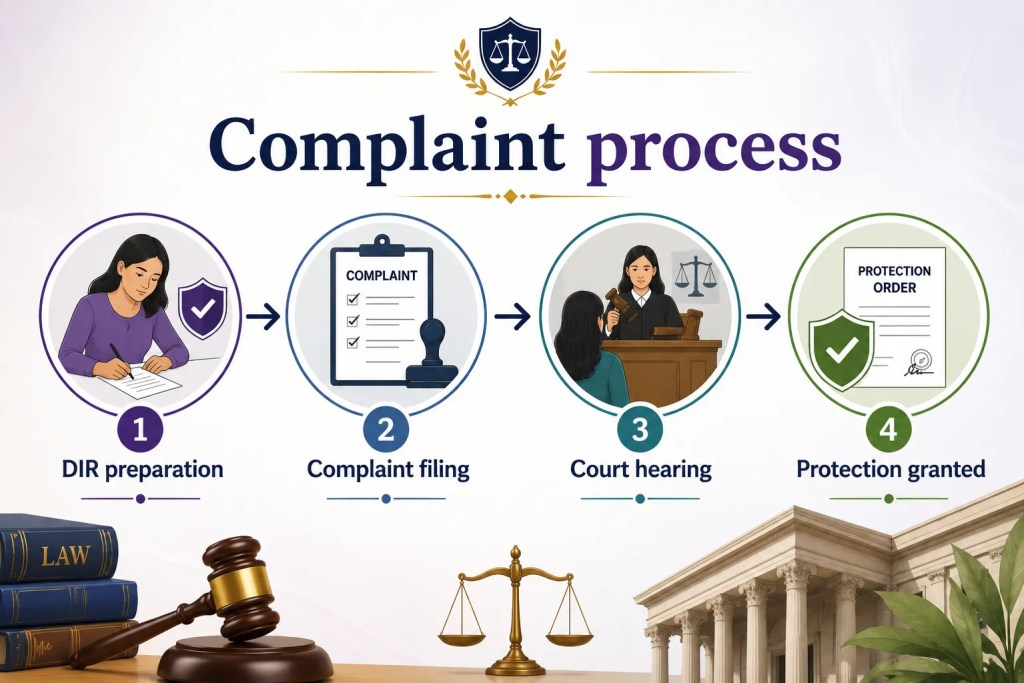
Once you decide to act, the process moves through these steps:
- Prepare the Domestic Incident Report (DIR): This is the foundational document under PWDVA. A Protection Officer or recognised NGO prepares it based on your account of the incidents, recording dates, nature of abuse, and reliefs sought.
- File the complaint: Submit to the Protection Officer, police station, NGO, or Magistrate.
- Court hearing for interim orders: The Magistrate lists the matter urgently and can pass interim restraining, residence, and maintenance orders at the first hearing.
- Document all evidence: Gather medical records, photographs of injuries, screenshots of threatening messages, and call recordings. For admissibility rules for digital evidence, see the guide on digital evidence in family cases.
Types of Protection Orders Available (संरक्षण आदेश के प्रकार)
- Protection Order (Restraining Order): Stops the abuser from contacting or approaching you.
- Residence Order: Confirms your right to live in the shared household. In-laws cannot evict you, per the Supreme Court in Satish Chander Ahuja v. Sneha Ahuja (2021).
- Monetary Relief: Covers medical costs, maintenance, and child care. See the full guide on maintenance claims in India.
- Custody Order: Grants immediate temporary custody of your children. See child custody laws in India for the complete framework.
- Compensation Order: Directs the abuser to pay damages for mental and physical harm under Section 22 PWDVA.
No. Under Section 17 PWDVA, every woman in a domestic relationship has the right to reside in the shared household and access all common areas, including the kitchen, regardless of whether she owns the property. The Supreme Court in Satish Chander Ahuja v. Sneha Ahuja (2021) confirmed that even if in-laws own the property, the woman has a legally enforceable right to reside there. Denying a woman access to the shared kitchen or rooms of the house is itself an act of economic and emotional abuse under PWDVA and is actionable. If you are being excluded from your marital home or shared areas, you can seek an emergency Residence Order enforceable by the police.
Key Supreme Court Judgments on Domestic Violence (महत्वपूर्ण न्यायिक निर्णय)
- Arnesh Kumar v. State of Bihar (2014): Arrest under BNS 85 must not be automatic. Police must record reasons before making an arrest.
- Indra Sarma v. V.K.V. Sarma (2013): PWDVA protection extends to women in live-in relationships (लिव-इन रिलेशनशिप में महिलाएं).
- Hiral P. Harsora v. Kusum Narottamdas Harsora (2016): A DVC case can be filed against female relatives of the husband, including the mother-in-law.
- Satish Chander Ahuja v. Sneha Ahuja (2021): Right to reside in the shared household is protected even when in-laws own the property.
- Shivangi Bansal v. Sahib Bansal (2025): No arrest for 60 days in BNS 85 cases; mandatory Family Welfare Committee process must be completed first.
For guidance on defending against false BNS 85 complaints, see the guide on how to safeguard against Section 85 BNS.
Role of a Domestic Violence Lawyer in Delhi NCR
Domestic violence cases (paribarik mamle / पारिवारिक मामले) involve simultaneous civil and criminal proceedings on tight legal timelines. A family lawyer for domestic violence (domestic violence family lawyers) ensures your DIR is precise, your petition is filed without delays, and emergency restraining orders are secured at the first hearing. Advocate Preeti JD handles domestic violence cases across Gurgaon, Delhi NCR, Faridabad, and Ghaziabad, and has experience in obtaining same-day emergency protection orders where safety is at immediate risk.
Conclusion
Domestic violence (घरेलू हिंसा) is both a civil wrong and a criminal offence under Indian law. Whether you are facing physical beating, verbal abuse, mental harassment, or economic deprivation, the law gives you access to immediate restraining orders, residence security, financial maintenance, and child custody protection under PWDVA and BNS Section 85.
Courts across Delhi NCR can act within 24 hours in urgent cases. For legal assistance for domestic violence in Delhi, Gurgaon, or anywhere in the region, contact Advocate Preeti JD for a confidential consultation.
FAQs
How do I get a restraining order in India against my husband or in-laws?
File a petition for a Protection Order in the Magistrate’s Court under Section 18 PWDVA through a Protection Officer or directly with a lawyer. Courts can grant an emergency ex parte order within 24 to 48 hours of filing without the abuser being present.
Which section applies when a husband beats his wife in India?
BNS Section 85 (which replaced IPC Section 498A on 1 July 2024) applies to cruelty by a husband or his relatives. BNS Section 86 defines cruelty. Both are cognizable and non-bailable offences.
Is verbal abuse a crime under Indian law?
Yes. Verbal abuse, threats, insults, and mental harassment are explicitly covered under PWDVA and BNS Section 86. You can file a DVC case for verbal and emotional abuse alone, without any physical violence.
Where do I register a domestic violence case (DVC case)?
Approach a Protection Officer, police station, recognised NGO, or the Magistrate’s Court directly. All four are valid under PWDVA. The Magistrate’s Court route is fastest for emergency restraining orders.
Can men file a domestic violence case in India?
PWDVA is gender-specific and applies only to women. Men facing cruelty can seek relief under general criminal provisions, file for divorce on grounds of cruelty under Section 13 of the Hindu Marriage Act, or approach the civil court for an injunction.
Can a DVC case and an FIR under BNS Section 85 be filed at the same time?
Yes. A DVC case (civil petition under PWDVA) seeking protection orders and a criminal FIR under BNS Section 85 seeking the abuser’s prosecution can be filed simultaneously and run in parallel.
Can I file a domestic violence case against my mother-in-law?
Yes. After the Hiral P. Harsora judgment (2016), PWDVA complaints can be filed against female relatives of the husband, including the mother-in-law and sister-in-law.
No. Section 17 PWDVA and the Satish Chander Ahuja judgment (2021) confirm your right to reside in and use the entire shared household. Restricting access to common areas is actionable as economic and emotional abuse under PWDVA.
How long does it take to get a restraining order (Protection Order) after filing?
An interim ex parte Protection Order can be passed at the very first hearing, within 24 to 48 hours of filing in urgent cases. Final permanent orders are issued after hearing both parties, typically within weeks to a few months.
What happens if the abuser violates a restraining order or Protection Order?
Violating a Protection Order under PWDVA is a criminal offence punishable with imprisonment up to one year or a fine of Rs. 20,000, or both. Report any violation to the police immediately, with the court order copy in hand.



0 Comments